Topics
We organise our actions in six thematic & strategic agendas:
Strategic Agendas:
Bio-economy
Circular Construction
Chemicals/Plastics
Manufacturing Industry
Food Chain
Water Cycles
Seven leverages provide additional support:
Leverage effects:
Lever Policy Instruments
Lever Circular Procurement
Lever Communication
Lever Innovation & Entrepreneurship
Lever Financing
Lever Jobs & Skills
Lever Research
What, why and how?
Why are we pursuing a circular economy?
Future visions 2050
How do we see our circular future?
About our management
Who steers what at Flanders Circular?
Hospitals and medicines as climate hotspots: why circular procurement makes a difference
Tuesday 2 September 2025
Climate change is without a doubt one of the greatest societal challenges of the 21st century. When we think about it, our minds often go straight to aviation, transport, or heavy industry. But healthcare also plays an important role: globally, the sector is responsible for 5 to 5.5% of CO₂ emissions - more than the entire aviation industry combined.
To tackle this impact, the Green Deal Sustainable Healthcare was launched on March 15, 2023. Since then, 229 organizations have already joined. Together, they are taking concrete steps - grouped into four themes - to make the healthcare sector more sustainable.
Hospitals are absolute hotspots in this regard. Think of their heavy use of energy, pharmaceuticals, disposable materials, and complex medical equipment. The breakdown of emissions shows clearly where the main challenges lie:
- 40–45%: medical materials (both single-use and equipment)
- 10–20%: pharmaceuticals
- 15–20%: energy consumption
- Remaining share: transport of staff, patients, and goods
On top of that, healthcare uses 13% of all virgin materials worldwide. Our material consumption is therefore almost twice as large as our CO₂ footprint.
In short: if we truly want to make healthcare sustainable, we need to focus on hospitals and pharmaceuticals.
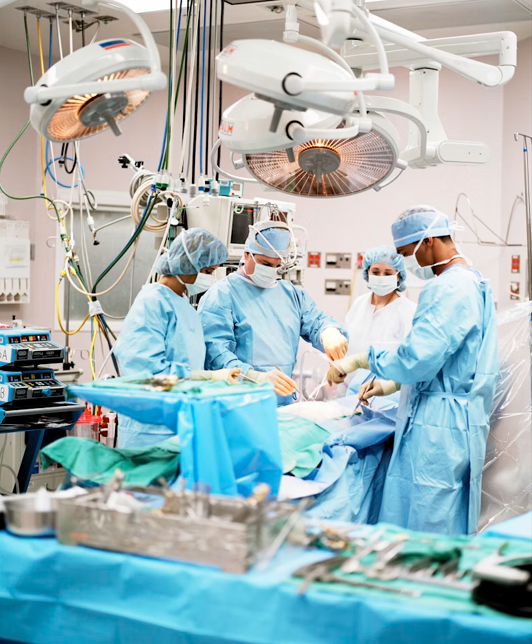
The dual challenge of sustainability
The healthcare sector carries a double responsibility: safeguarding our health while at the same time reducing its ecological footprint. This transition is complex, because:
-
The supply chain challenge: 70–75% of a hospital’s emissions lie in the supply chain (Scope 3). Suppliers, producers of medical materials, and the pharmaceutical sector must also be part of the change.
-
Internal dynamics: sustainability requires collaboration between doctors, nurses, purchasers, sustainability coordinators, hospital hygiene teams, and waste management. Only a combination of top-down (boards, management, procurement policies) and bottom-up (e.g. green teams on the work floor) can set change in motion.
In addition, Europe is raising the bar: with the Corporate Sustainability Reporting Directive (CSRD), companies and institutions will be required from 2025 onwards to report more transparently on their sustainability performance, including all three emission scopes. For healthcare institutions, this serves as an extra incentive to embed sustainability structurally.
Circular procurement as a lever
One of the most powerful instruments to make this transition happen is circular procurement. The principle is simple: purchasing products and materials in such a way that they last longer, can be reused, and generate less waste.
What started as a sub-theme within the theme team ‘Materials and Waste’ of the Green Deal Sustainable Healthcare (GDDZ) soon grew into a cross-cutting theme. Sustainable procurement policy turned out to be a pathway to achieving real impact. This led to the creation of the Learning Network on Circular Procurement (LNCA).
The Learning Network on Circular Procurement (LNCP)
The LNCP brings together purchasers, policymakers, healthcare providers, and suppliers around one goal: accelerating circular and sustainable procurement. This is not a non-committal think tank, but an action-oriented network working towards concrete results and practical tools for the healthcare sector.
By 2026, the LNCP aims to achieve at least two milestones:
- A joint set of requirements (Joint Statement of Demand) for healthcare institutions, focused on a specific product category. This requirements package is drawn up together with suppliers and manufacturers, ensuring it is both realistic and ambitious. The chosen product groups are pharmaceuticals and food.
- An accessible guideline for procurers, enabling hospitals and healthcare facilities without large sustainability teams to get started right away.
Starting point: pharmaceuticals as a product category
Within the LNCP, it was decided to start the joint requirements package with pharmaceuticals. The reason is clear:
- They are responsible for 31% of Scope 3 emissions in Belgian healthcare.
- Each year, 6% of purchased medicines are lost, often due to inefficient return flows.
- Because of their high purchase volumes and frequent replacement, pharmaceuticals represent a powerful lever for change.
- The market is willing to move towards sustainability but is asking for direction and clarity from the healthcare sector. Currently, transparency, standardization, and knowledge are lacking, making it difficult for purchasers and prescribers to make sustainable choices.
With a joint requirements package, the healthcare sector can anchor sustainable criteria and structurally guide the pharmaceutical industry towards a greener future.
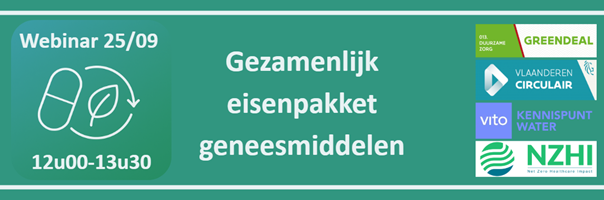
How can we make pharmaceuticals more sustainable and circular - and how can the healthcare sector jointly steer this through a shared requirements package? We will discover the answers during the interactive webinar Co-creation for Sustainable Healthcare: a JSD for Pharmaceuticals on Thursday, 25 September 2025, from 12:00 to 13:30.
Building knowledge and tools together
The transition to sustainable healthcare does not stop with the LNCP. Circular Flanders is developing an online learning hub specifically for the healthcare sector, featuring practical examples, inspiration, and tools for circular procurement. This way, the knowledge that is built up will be broadly shared, even after the current Green Deal Sustainable Healthcare comes to an end.
Circular Flanders, in collaboration with sustainability consultancy Studio D, aims to reach as many purchasers in Flanders as possible with knowledge, insights, and activation around sustainable and circular procurement. That’s why we are pleased to offer procurement teams a free workshop or training. We want to encourage purchasers to integrate sustainability and circularity right from the start of the procurement process. By discussing their own cases, we explore strategies to take concrete action and look at realistic barriers - and how to overcome them - to effectively adapt procedures and behavior.
From sharing knowledge to experimenting in practice
With the Targeted Call Circular Healthcare 2023, Circular Flanders/OVAM gave a strong boost to innovation in the healthcare sector. Two million euros were allocated to bring together healthcare institutions, governments, producers, and researchers around projects that put reuse, re-sterilization, and circular procurement into practice. In total, seventeen partnerships were launched, each with a concrete experiment paving the way towards a healthcare sector with less waste and lower CO₂ emissions. These projects will run until the end of 2025, after which the results and lessons learned will be shared with the entire sector. In this way, the call is evolving into a catalyst that transforms circular healthcare from vision into reality.
The healthcare sector is at a tipping point. With its considerable climate impact, it cannot afford to stand still. Circular procurement, supported by the LNCA and the Green Deal Sustainable Healthcare, offers a concrete and powerful path forward. By formulating joint requirements, making the supply chain more transparent, and providing purchasers with practical tools, the healthcare sector can demonstrate that sustainability also works in practice. This way, healthcare becomes not only better for patients, but also more efficient and future-proof for society as a whole.
Reading and listening tips
- Publication: Developing a measurement and determination strategy for calculating the healthcare sector’s CO₂ footprint
- Article: Rethinking endoscopy for a lower environmental impact
- Report: LCA reusable and single-use surgical gowns and drapes
- Website: De Groene OK (NL)
Four emergency physicians from ZOL (Ziekenhuis Oost-Limburg) host the monthly podcast ‘Spoedcast’ (in Dutch). In this episode, they dive into a topic that is literally burning hot: sustainability in healthcare. Their guest is none other than Brecht De Tavernier, emergency physician, department head, and founder of Net Zero Healthcare Impact. Whether you are a doctor, nurse, policymaker, or concerned citizen: this episode will get you thinking – and acting. Emergency care, but with a vision for the future.


